Working out who should be Responsible, Accountable, Consulted and Informed on a project should make roles much clearer, right?
Wrong.
Every time someone asks me for a RACI, my heart sinks. I have spent so much time agonising over so many RACIs that only a few people have even skim read. There must be dozens of massive spreadsheets I’ve written over the years to try and answer some basic questions about roles and responsibilities. Yet every time questions pop up, it seems unclear. A RACI might be a helpful starting point, but as soon as your project starts you will think of things you haven’t covered, or discover nuances in things you have covered.
If I’m honest, my RACIs have been expectation setting of the worst kind. It’s me saying ‘I’m not going to consult you about an important decision, and I’ll use this spreadsheet you won’t read to justify this to you in a few months time’. And that’s… not great?
I’m not saying that we shouldn’t set expectations, or that we should involve an unmanageable number of people in every tiny decision. But we use RACIs as the decision making equivalent of security theatre. It’s a bureaucratic piece of admin we spend a disproportionate amount of time on, given how little they help in day to day work.
What does help instead of RACIs?
The goal of RACIs is laudable. We want to be clearer about two things: firstly, who is responsible for tasks, and secondly, how decisions work – who gets to make or input on the decision and who is just informed. One spreadsheet can’t do all of this. But agile tools can be a significant help.
Let’s look at responsibilities first. Next week, we will dig into how to get input into decisions.
Use stand-ups to get clearer on responsibilities
The only way to get clearer on responsibilities is to have regular conversations about them. We’re rubbish at predicting the future and it’s next to impossible to outline all the tasks involved in a project at the outset. So don’t try to do that!
Taking an agile approach means planning in detail for the short term, and keeping it very top-line for the longer term. This is both much more realistic, and much simpler and easier to do.
One tool lots of teams I work with have found really helpful for this is a stand-up. Stand-ups are short, frequent meetings to streamline team communication and quickly address concerns. They take 10-15 minutes and are traditionally held daily, though I’ve found that weekly or twice-weekly can work well depending on the type of work.
For a stand-up to work well, you need a visual record of your work. You can use Microsoft Planner, Trello, monday.com or a similar alternative for this. The tool isn’t important, but how you use it is. All you need to do is make sure you’re capturing all the tasks for your piece of work under either “work in progress” for things you are working on now, “blocked” where you are waiting for something outside your control, and “to do” for anything you haven’t got to yet.
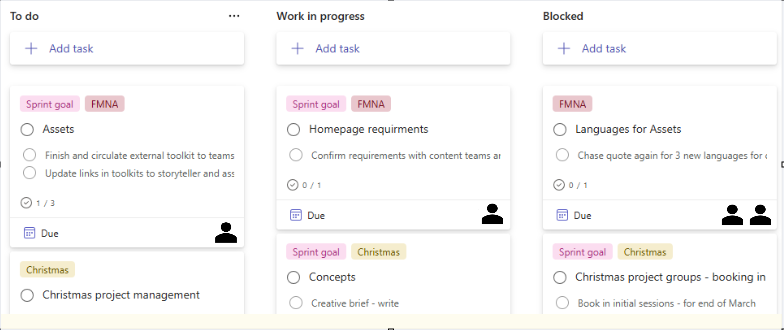
In a stand-up, each person should run through the tasks with their name on that are in progress. They should do this very quickly, just flagging if there’s anything unclear or where they might need some help. They should briefly check what’s blocked or still to do to work out whether they want to move anything to “in progress”, before passing to the next person.
This is a very simple format that you should be able to get through quickly. And there’s lots of benefits to holding stand-ups. They help you keep track of lots of moving pieces and they are an efficient way to make sure you are collaborating effectively. They also mean you are having regular conversations about workload so it’s easier to split this more evenly across the team.
But an underrated side effect of stand-ups is they quickly surface unclear responsibilities. You should spot immediately if there’s a task with no one assigned to it, or if someone is struggling with a task that’s bigger than they can handle. There’s no more mystery, no more hoping someone else will jump in. Having a regular, structured conversation means you will achieve clarity much more quickly.
That’s one way agile helps with clarifying responsibilities. Next week, we’ll look at the other important element of RACI and consider how you should involve people in your decision making.
In the meantime, I’d love to hear what you make of RACIs. Am I the only one who hates them? How do you approach clarifying responsibilities?
Leave a Reply to The agile approach to project planning – Agile for Everyone Cancel reply