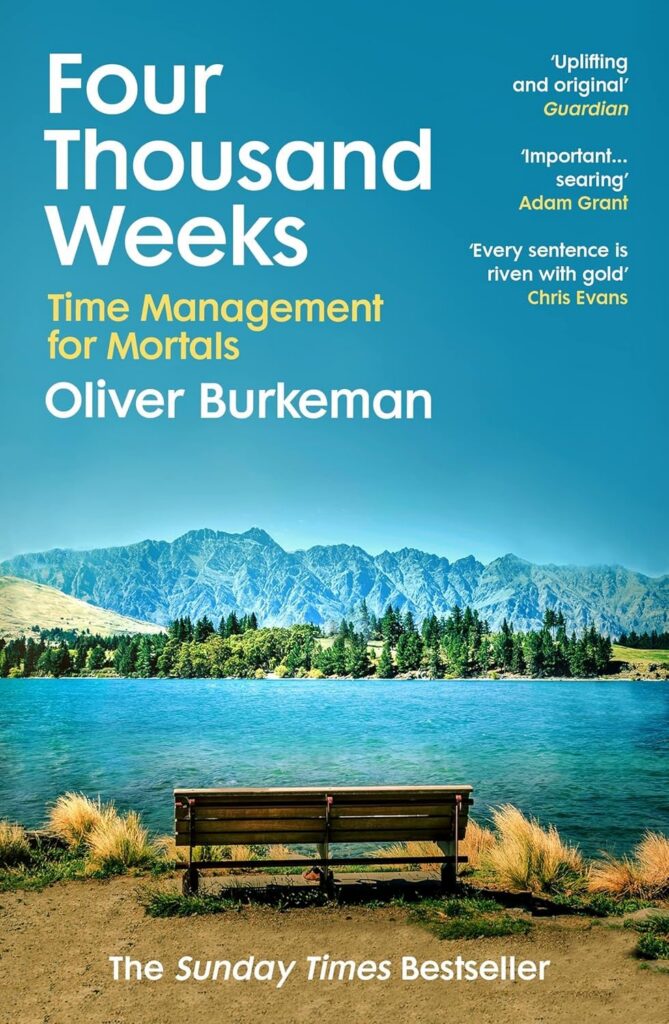
Four Thousand Weeks by Oliver Burkeman has changed how I think about agile. That’s despite the book being in no sense about agile. It doesn’t even mention it beyond a passing discussion of Kanban. But this book has been fundamental in shifting how I think about time, with some serious lessons for agile working.
Many books make the point that time is finite. Few manage to get the point across as effectively as this one, or to consider so philosophically what this means for how we live. The four thousand weeks of the title – the typical human lifespan – limits what we can do in ways that can almost be freeing if we choose.
How we think about time matters
Until I read this book, I was only vaguely aware that you could have a different attitude to time than our cultural norm. But of course how we currently think about time is a fairly recent phenomenon.
As Burkeman points out, medieval peasants didn’t just lack our worries about work-life balance, they wouldn’t have experienced time as the abstract entity that we see it as. If you get up when the sun rises and go to bed at dusk, and your life is driven by the seasons and when the cows need milking, your attitude will be very different to one driven by the clock. You can’t get ahead on milking the cows or harvest the crops at a time that is convenient to you. These things happen when they happen.
And despite the hardships of peasant life, they didn’t feel stuck with too much to do like we do. Our technological advances and labour saving devices have not made time feel more abundant. Somehow, it’s the reverse. Getting more done often leaves us feeling busier and more anxious and somehow empty as a result.
Too many of us live with a ‘when-I-finally’ mindset, stuck in the idea that ‘when I finally get this big project done/ hire a full team/ move house/ meet the right person… then I can relax and start living the life I was always meant to be living’. But there’s always something else you want to achieve when you get there.
When you recognise that you can’t do everything, you stop trying to do everything. You stop feeling like if you just clear the decks you will finally get on top of things. You will never clear the decks.
The book doesn’t advocate that we think like peasants, but it does illustrate that we can think about time differently from the cultural default. Because, as Burkeman describes, ‘this attitude towards time sets up a a rigged game in which it’s impossible ever to feel as though you’re doing well enough. Instead of simply living our lives as they unfold in time – instead of just being time, you might say – it becomes difficult not to value each moment primarily according to its usefulness for some future goal, or for some future oasis of relaxation you hope to reach once your tasks are finally “out of the way”.’
Choosing what not to do
One of the most important implications of the fact that time is finite is that good time management techniques doesn’t just help you get more done, but helps you neglect the right things. In agile, we’d call this ‘maximising the work not done’.
I remember the first time this was explained to me. I was working on an improved process for volunteer groups to order fundraising materials and I knew they would find it much more convenient if those materials could be batched to make it easier to divide amongst themselves. I was trying to work out the logistics of making this happen, and I was very proud that we’d come up with the idea. But when someone asked what would be different as a result of this change, I realised the answer was… nothing. The groups were ordering the materials, whether or not I made this complex and logistically challenging change. This was work I could easily not do without impacting my results.
I’ve written about backlog refinement as a practice that helps you prioritise a few things to focus on. Implicit in choosing what to do is choosing what not to do, and that’s almost more important. As the book points out, spending several of your four thousand weeks on something inherently means choosing not to spend it on something else, whether you recognise it or not.
One thing at a time
One of Burkeman’s recommendations is to serialise what you focus on. Pick one big project to focus on now, and wait till you finish to choose the next one. This is probably a familiar idea from agile, and it’s amazing how much more you can achieve if you are really only focused on one thing for a while.
Burkeman also cites Hofstader’s Law, that things take longer than you expect, even when you take Hofstader’s law into account. He gives it an unexpected corollary that perhaps we should resist the urge to pad our timelines, because things will inevitably take longer when we allow more time for them. This is another reason why design sprints, week-long workshops focused on exploring one problem in depth, work so well. A sprint is always structured to involve testing with your target audience on the final day. That in-built timeline means there can be no slippage into the following week.
Develop a taste for having problems
The final idea that Burkeman shares that has really stuck with me is about considering patience as a creative force. We want quick answers to our problems, but interesting problems don’t have quick solutions. You often have to stay with a question and endure the discomfort of not knowing for an answer to emerge.
I think so often we use productivity as a way to distract ourselves from these difficult questions. It’s easy to abandon a tricky project if you’ve got 16 other things you’re supposedly focussing on. But often there’s gold on the other side of the difficulty. If you push through the discomfort, valuable insights emerge. That’s why a lot of facilitation and coaching is really just about slowing people down – encouraging them to stare a difficult problem in the face for a bit longer than they would in their day-to-day.
The wider insight is to not be afraid of difficulty, to welcome even incremental change on problems that matter. Burkeman calls this developing a taste for having problems, and I love that framing. I also love the question he asks towards the end: ‘Where in your work are you currently pursing comfort, when what’s called for is a little discomfort?’.
Where should you be pursuing more discomfort? Share your reflections in the comments and sign up to my newsletter for monthly agile advice and tips.
Leave a Reply