The trick with prioritising is not actually prioritising. It’s deprioritising. We’re very good at choosing things we want to do, but understandably much less good at picking what we won’t do.
Two pieces of advice make prioritising (and de-prioritising) work much easier: do it regularly and do it together.
If you are prioritising on a regular basis – say monthly – then it is much easier to choose what to focus on. If you don’t pick a particular task this month you can always go back to it next month. You have a regular opportunity to course correct if things go wrong or you learn something new.
Prioritising together leads to better decisions. How many times has a manager chosen something, only to learn that actually it’s not realistic, or overlooks a key dependency? I know I’ve done this frequently! Prioritising together as a team means that not only are you using everyone’s knowledge and expertise, but that you will all be bought in to your choices. It’s also a big shift towards being a more empowering manager.
Thankfully, there is an established process that gets you to do this collective prioritisation of work together. It’s called backlog refinement.
Backlog refinement, step-by-step
Before you get started, you need to build a backlog. This is a list of all the tasks you might like to do. Scour your current to do lists, any questions that have been nagging at you, things you’ve talked about doing someday, opportunities you might wan to explore and so on, and put these all in one long list. You’re not committing to doing something if you put it on your backlog, but you will consider it when it’s time to prioritise.
Then your regular backlog refinement session should go something like this.
- Check in (5 minutes): Each participant answers a warm-up question in turn.
- Review your priorities from last time (10 minutes): Ask people to individually tick off what you said you would do last time. Briefly discuss things that haven’t been completed.
- Retrospective (20 minutes): Give participants four minutes to answer each of the following questions in turn:
What’s gone well over the last month?
What’s gone less well?
Group together any themes and spend a few minutes discussing these as a group, before moving on to what you might like to try differently next month. Take notes of any actions that come out. - Choose next month’s priorities (15 minutes): Your goal here is to choose 3-5 priorities from your backlog to prioritise for the next month.
- Ask people to individually shortlist possible priorities first, by silently grouping those post-its together.
- Take two of the shortlisted priorities and ask which of them would be more impactful to focus on for the next month. Get people to shout out answers! Start ordering the priorities with the most impactful one at the top. Add in one priority at a time and compare it to priorities already discussed till you have ordered your shortlist.
- Decide the cut-off point – how much of your list is realistic to do in the next month? Be ruthless – if you don’t think you can do it, it’s not a priority.
- Break the task down (10 minutes): Ask participants to individually list out tasks and responsibilities for the priorities that are above your cut-off. If you are using stand-ups, one of you should transfer the tasks across to your Kanban board after the meeting.
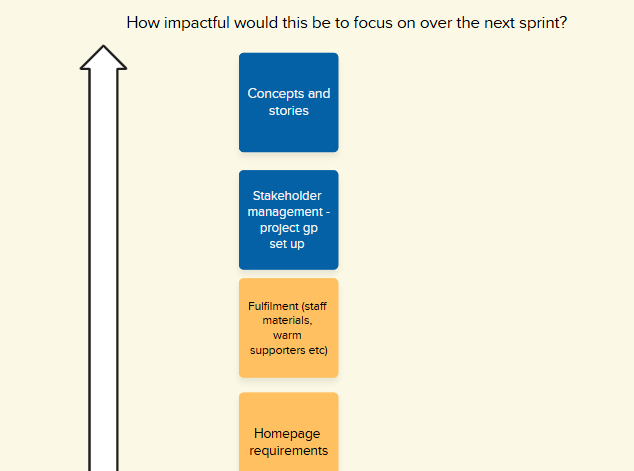
What if something never gets prioritised?
If something never gets prioritised, then it genuinely isn’t a priority. And that’s ok! We can’t do everything. As long as you are regularly creating space to genuinely reflect and consider what would be most impactful to put your time into, if something doesn’t make the list then it doesn’t make the list.
Let’s face it, you probably weren’t doing those things under your old system. And if you were, what were you not doing instead? It’s much better to be honest with yourselves about the choices you are making.
What if we keep getting additional priorities imposed on us?
It’s next to impossible to prioritise if a week from now you’ll be told to focus on something else, and that’s true whether or not you are using backlog refinement.
If this is an issue for you, make sure you’ve communicated clearly about when and how you prioritise and set expectations what’s realistic for you to take on at any one time. It’s easier for others to accept that x isn’t the focus right now if they understand you are currently working on more important tasks y and z, but you’ll take another look at x on the first Monday of the month, say.
If additional prioritises are coming from more senior stakeholders, it’s worth spending time getting really aligned about the outcomes you want to achieve. Once they are bought into your overall goals it’s easier for them to leave it to you to decide how to achieve those. It can also be helpful to get them to shadow one of your backlog refinement sessions so they understand how you are making choices and advocate for your priorities amongst their peers.
You get better at prioritising over time
I’ve noticed several patterns with teams who use backlog refinement regularly.
After a couple of months, almost every group realises that they are prioritising too many things and adjusts. I think you have to experience this first-hand to really appreciate it and be more realistic about what you take on.
Experienced teams also get more decisive. Prioritising is a muscle, and the more you use it the more you strengthen it. You can make those choices, knowing that what you prioritise now doesn’t have to be the focus forever. You’ll also learn more about your colleagues perspectives – what their likely take will be and where it would be particularly helpful to get their input. All of this means you get better at prioritising over time.
Do you use backlog refinement? What impact has it had for you?
This is part of a series on agile ceremonies. We’ve already covered stand-ups and retros. Subscribe to my monthly newsletter so you don’t miss a post.
Leave a Reply