If you are feeling frustrated by interminable status meetings, or your team is failing to communicate enough, stand-ups might be the solution. These are quick meetings, traditionally held daily, allowing fine grain coordination. Having an efficient, regular check-in like this allows you to get clear on what you are trying to achieve together, hold each other accountable and notice if anyone needs help.
There’s some flex in the format: for non-tech teams, I usually recommend holding these weekly or twice-weekly. But there’s also an awful lot of things that get called a stand-up that are something else entirely!
The most important thing that often gets missed is that stand-ups should be quick, no more than 15 minutes or so. If they take longer than that, you’re almost certainly repeating information or discussing things that aren’t relevant to the whole team.
Stand-ups aren’t the same as a status update. They are deliberately brief, aiming only to make sure everyone is clear on what they are working on and there’s no blockers or duplication. If something needs more discussion, have a conversation outside the stand-up to resolve it.
Stand-ups, step by step
Before you start holding stand-ups, you need a Kanban board. This is a visual record of what the team is working on, split into columns like “in progress”, “blocked” and “to do” (for anything you haven’t got to yet). I recommend using something like Trello or Planner for this and keeping it simple. Don’t worry about capturing everything perfectly straight away – you will add to it as you go.
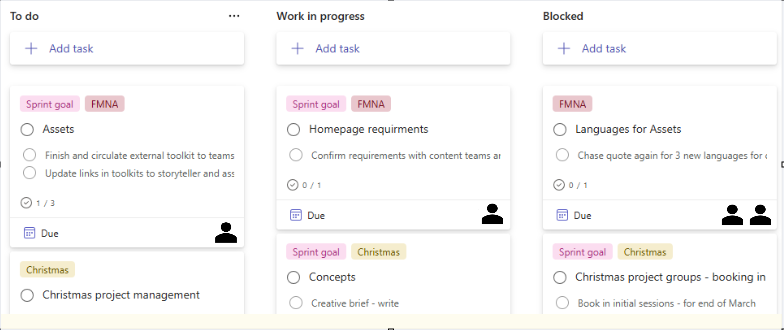
Then during your stand-up, one person should share the Kanban board on their screen. They go to each person in turn, filtering the tasks on the board for ones assigned to them.
- First, run through the tasks under “in progress” one by one – is there anything you can tick off? Is anything unclear or blocked?
- Next, check if there’s anything you in the “to do” column that you want to start working on before the next meeting. If so, move it across to “in progress”.
- Finally, review what’s in “blocked”. Do you need to chase those tasks and move them over to work in progress?
This should only take a few minutes per person.
How not to hold stand-ups
I’ve mentioned that stand-ups should be quick. If you’re part of a stand-up that’s taking much longer than 15 minutes, you’ve probably lost sight of the purpose of the meeting. My guess is that at least some of the attendees are frustrated and feel it’s not a good use of their time!
If that’s the case, I would start by reviewing the format. Are you getting into protracted discussion about tasks that should take place elsewhere? Is the chair encouraging on swift check-ins, following the questions above and focused on work in progress rather than future tasks?
Often, lengthy stand-ups is a sign that you aren’t holding them often enough. If you can’t remember necessary context for tasks on your Kanban board, or if you are repeating things each time, try meeting more regularly. Having quicker, more effective stand-ups once or twice a week is much more helpful than winding lengthy discussions once a fortnight.
Watch out for deadlines. As in project plans, using deadlines in a stand-up slows you down and encourages you to prioritise solely based on urgency, rather than importance. As long as you are reviewing work on a regular basis, you shouldn’t need deadlines to make sure you are doing work on time.
You don’t need to update the board outside of the stand-up either – doing it there and then means you are sharing the most up-to-date information and don’t need to do additional admin outside of the meeting.
My final watch out is to make sure you haven’t got an overwhelming long list of things listed as “in progress”. Firstly, this will make your stand-ups take longer. More importantly, it also makes it harder for people to tell what they are focusing on. Prioritising a few things over a short period makes it much easier to make sustained progress. Limit the “in progress” column to things you are actually working on between now and the next meeting and don’t allow this to become unrealistic.
How to hold even better stand-ups
Ok, so you’ve got the basics of stand-ups down. How can you make them even better?
Make sure you are rotating the chair. If everyone in the team takes it in turns to run the stand-up, you all quickly learn what works well in the format. It also means you share both the work and the power that comes from facilitating. It’s a subtle nudge towards more empowered teams if everyone can chair rather than just the manager, and it makes the team more resilient for cases where the usual chair is away.
Another empowering techniques is for the chair to use coaching-style questions when they notice something is off. Saying, “This task has been blocked for a while. What do we need to take it forward?” or, “Is this set of tasks realistic?” helps everyone keep themselves accountable in a supportive way. I also like to ask “What did we notice about our stand-up today?” at the end. Often, something will come up that helps us improve the format or work better together.
If things frequently emerge in your stand-ups that need more discussion, one final idea you might try is magic time. This means blocking out a bit of time in your diaries immediately after the meeting. It’s not a meeting in itself, but if you’ve all held the time then it’s easy to grab some time with anyone you need to chat further with.
Do you hold stand-ups? What practices work for you?
This is the first in a series on agile ceremonies. Subscribe to my monthly newsletter to get a round-up of the rest of the posts.
Leave a Reply