Teams benefit from two types of reflection: thinking about what they did and how they did it. Almost everyone knows they should be thinking about the former, regularly evaluating their work and reviewing how they did against their targets. But the latter gets much less attention. And this is odd, because how we work is much more within our control.
Retros, or retrospectives, are a structured way for groups to reflect on how they are working together. Retros are the agile tool I recommend more than any other. I don’t think I’ve ever worked with a team who wouldn’t benefit from some reflection time like this.
Retros are even more important if you are trying new things (which I hope you are!). When you are experimenting with your ways of working, having a regular opportunity to step back and reflect on it is really valuable.
Retros, step by step
Here’s a simple agenda for a monthly retro.
- Check in (5 minutes): Each participant answers a quick check-in question in turn (eg “what’s been a highlight from your week?”)
- Individual reflection(15 minutes): Give participants five minutes on each of the questions below. Ask them to note down their thoughts privately, using private mode on a virtual whiteboard like Mural, or by writing physical post-its where others can’t see them.
- What’s gone well over the last month?
- What’s gone less well?
- What would we like to do differently next month?
- Reveal and discuss (15 minutes): Turn off private mode or ask people to add their post-its to a central place under the question headings. Ask everyone to read over what’s written and group any similar post-its together. Then ask for any reflections. Are there any themes?
- Vote (2 minutes): Give three votes to place on things they would like to explore further.
- Problem solving (15 minutes): Look at the top 2-3 issues from voting in turn. Discuss as a group how you could approach this and what actions you would like to take.
- Check out (5 minutes): Summarise any actions.
There’s lots of fun formats out there if you want to mix this up a bit. My favourite is Rose, Thorn, Bud, replacing the three questions in step 2 with roses to celebrate, thorns to address or buds to grow. Depending on your team, you might enjoy some more creative prompts, or you might just be happy keeping it simple!
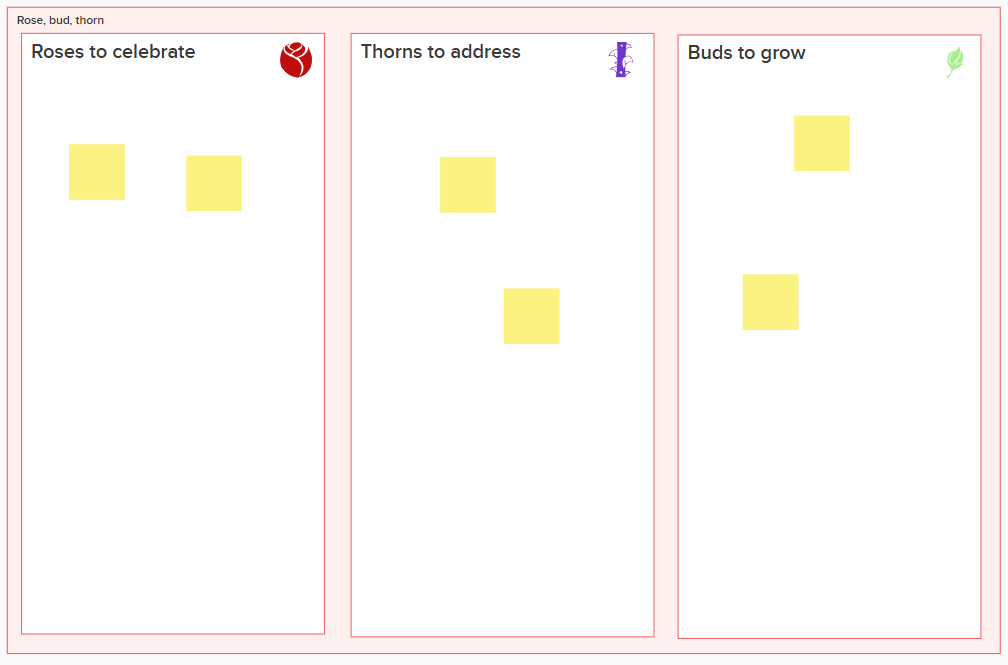
Encouraging open reflection is the heart of a good retro
Retros work when people feel comfortable sharing both positive and negative feedback. You want to create a safe space to both celebrate what’s gone well and to tackle any issues that emerge. There’s a few things you can do to make this easier.
As with stand-ups, I recommend rotating the chair of your retros so that you are distributing the power more evenly across your team.
You might also notice a couple of things in the sample agenda above. Firstly, there’s options for people to contribute both verbally and in writing. This allows people to raise things in the way that best suits them. I also recommend allowing people to input privately, at least at first, as it can be easier to raise tricky topics this way. Setting timers for people to add comments helps too: five minutes isn’t an eternity, but it’s long enough to make it clear that you are expecting constructive feedback.
Everything we covered in how to be an unusually good facilitator also applies here. You have a head start with retros because they are an established format that’s already structured around how people think. But if you want to take your retros further, consider the questions you ask in group discussion and make sure you are comfortable with silence in meetings for the individual bits.
The regular rhythm is what makes retros work
I encourage teams to schedule retros monthly or at another regular interval. The regular rhythm means they know they have a place they can raise issues and so don’t need to bottle things up. Holding retros regularly also means the issues raised are easier to tackle, and can be tackled more promptly. There’s nothing worse than learning about something six months into a project that you could have addressed ages ago.
Of course, you need to be able to demonstrate that you are addressing issues raised in your retros. That’s why I recommend voting to choose 2-3 things to focus on, to keep it manageable. Make sure you’ve worked out who is responsible for any actions and transfer those to your Kanban board if you have one. It can also be helpful to spend a couple of minutes at the beginning of each retro reviewing what you said you’d do last time.
Do you hold retros? What works well for you?
This is part of a series on agile ceremonies. Check out the previous blog on stand-ups and subscribe to receive a monthly round-up of posts.
Leave a Reply