It’s not that hard to be unusually good at facilitation, because most people don’t know the first thing about it. It’s a low bar to clear! With a little knowledge, you can be delivering workshops and meetings that stand out from the crowd.
This is probably overkill for simple meetings like one-to-ones or stand-ups. But for anything more complicated, there’s a few things you need to know.
Remember what meetings are for
Meetings are for interactions. If all the information in your meeting is going one way, that’s not a meeting. It should have been a webinar, or better yet, an email. Meetings are for back and forth –whether you need to hear different opinions, generate ideas or make a decision.
If it’s not interactive, it shouldn’t be a meeting. But you can think pretty broadly about how to make it interactive. Here’s a few ideas.
- Build in genuine time for open group discussion, making this the focus rather than an afterthought at the end of a long presentation.
- Ask each meeting participant in turn for a reaction to an idea or question.
- Split into pairs or small groups for more focused discussions.
- Get people to contribute ideas in writing in the chat or on post-its.
Getting people to write things down in silence is a surprisingly powerful tool that is underused in meetings. It’s much more efficient in getting a large volume of input quickly than discussing as a group, and it allows everyone to contribute on an equal footing. This can be particularly helpful in ideation (as we’ll explore next week), but it’s useful in lots of different settings.
Whatever you choose, if it’s a long meeting make sure you mix up your formats to keep people engaged and appeal to different styles. This feeds into my next point.
Structuring meetings well is the key to good facilitation
People often think that the secret to good workshops is knowing lots of possible activities to draw on. And whilst that can be helpful, it’s not really the secret.
The secret is structure. If you start and end your meeting well, and structure the session around how people think, your sessions will dramatically improve.
Less complex meetings need less complex structure. But if you’ve got more than a handful of people for more than 45 minutes, it’s definitely worth taking into account. Start with an icebreaker, so that everyone gets present, introduces themselves if necessary and becomes familiar with any tech you are using.
People often skip the icebreaker because it feels a bit cheesy or a waste of time, but the impact of a good icebreaker can be felt throughout the meeting, especially if you are working with quieter groups or people who don’t know each other well. It’s amazing how much more you’ll hear from shyer people if they’ve had the chance to say something early on in the meeting. So build this into your plans with an icebreaker that gets everyone sharing. Use a check-in question generator if you need inspiration.
Allow time to end the session well. This meas recapping and summarising any actions and ideally getting feedback about how the session went.
So far this is probably all things you already know, at least in theory. But do you know about how to structure meetings for the different types of thinking?
Structure your meeting around how people think
Good thinking needs two sorts of brain processes: divergent and convergent thinking. Divergent thinking is expansive. It’s all about taking on new insights or coming up with new ideas. It’s the opposite of convergent thinking, where you narrow down by evaluating or prioritising.
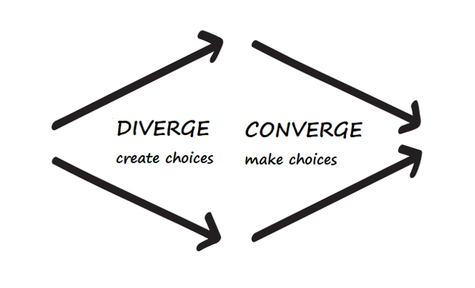
Most meetings need both types of thinking. If you are trying to make a decision, you should consider it from multiple angles (divergent thinking) before settling on one (convergent thinking). But you can’t do both at once. Choosing between options as you think of them shuts down discussion and makes people self-censor.
So don’t do both at once! Make them separate agenda items, and redirect people if they start evaluating too early.
Ask good questions
So, you have warmed up your meeting and you’ve identified some topics for divergent thinking. How do you get people talking? You ask a good question.
A good question is simple and easy to understand and doesn’t have an answer built in. ‘Have you thought about x?’ is not a real question! Instead try questions like:
- What’s most important here?
- What are some ways we could approach this?
- What would a good outcome be?
- What’s getting in the way?
Remember, you can get responses verbally or in writing. If you’re discussing as a group, pause after you ask the question! Hold the silence and wait for someone to speak. It can feel uncomfortable, but eventually someone will chip in and get the ball rolling. And then you’re off!
Subscribe for more facilitation secrets
Mastering structure, interactivity and questions should be enough to make you an unusually good facilitator. Next week, we’ll look specifically at one of the most popular forms of facilitation: idea generation workshops.
Sign up to my newsletter so you don’t miss a post. You’ll also get a free guide on how to use agile to make better decisions. This includes to a deep dive into convergent and divergent thinking and some of my favourite tools to make convergent thinking much easier.
In the meantime, what have you noticed about the structure of good meetings?
Leave a Reply