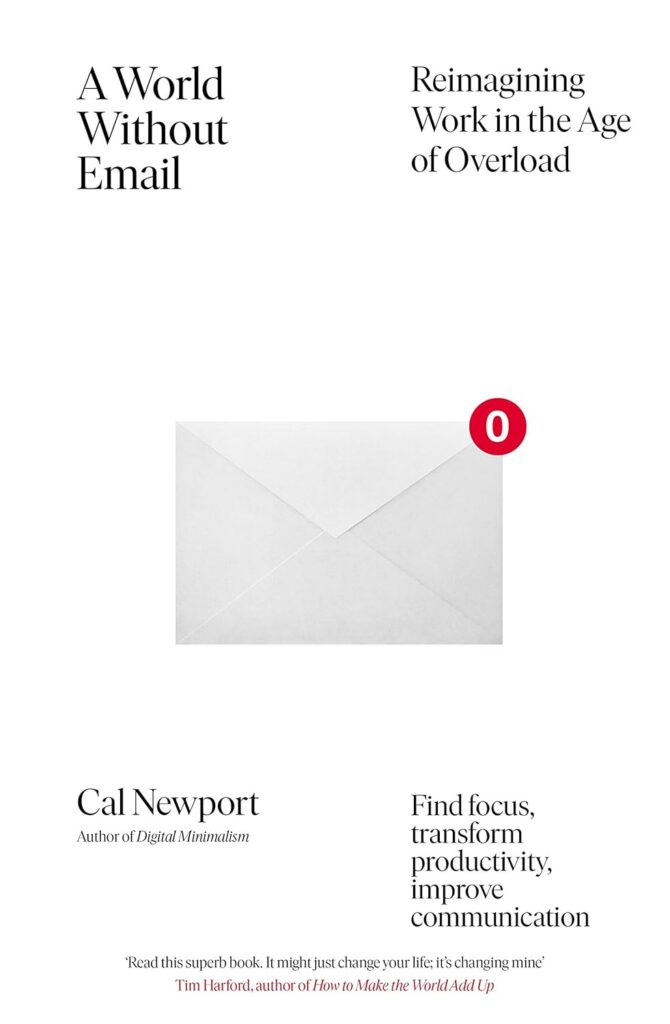
Cal Newport’s A World Without Email has a provocative theme: that we should structure our work so as to minimise email and other constant electronic communication that’s become the norm for many of us.
It’s another sneaky agile book. Whilst it doesn’t describe itself as being about agile, many of the ideas resonate with agile approaches. And the idea that it’s worth taking a step back to review your ways of working is as true for agile as it is for the practices within the book.
Why email sucks
The book argues that we unquestionably assume email transformed work for good. ‘According to this premise,’ it says, ‘if you feel overwhelmed by tools like email or instant messenger, it’s because your personal habits are sloppy: you need to batch your inbox checks and turn off your notifications, and write clearer subject lines!’. But email and similar tools have changed the very nature of how we work, often in troubling ways.
The assumption that we should always be available and interruptible (what Newport calls the hyperactive hive mind) is ubiquitous in knowledge work. But we work better and are more productive when we can focus properly. We all know the harm of multi-tasking, but we fail to appreciate the ways email and other forms of electronic communication encourage it. If you are in and out of your email inbox all of the time it becomes next to impossible to pay attention to your main task.
Research shows that there’s a cognitive cost to switching your focus from one task to another. It might just be a quick email check, but the attention residue that lingers for a long time after you’ve closed your inbox. This doesn’t just harm our productivity, it makes us miserable! That horrible foggy feeling when your mind has been pulled in too many directions is the result of this kind of task switching.
Kanban can help reduce email
Like several of the sneakily agile books I’ve reviewed, A World Without Email advocates using a Kanban board with a regular review meeting (or what I would call a stand-up). I’ve sung the praises of stand-ups before, especially the impact they can have on accountability, but Newport is right to highlight how they can reduce email too.
Newport says that ‘a regular rhythm of efficient meetings can replace 90 per cent of hive mind messaging, if you have a way to keep track of what needs to be discussed in these meetings’. I’ve often found that teams that hold stand-ups rely less on email and IM as he describes. It’s often quicker to address a question in a quick chat in your stand-up than to write a lengthy email. And fewer questions even emerge if you are having regular conversations about your immediate priorities.
The book has several helpful builds to strengthen this. He encourages you to shift as much as possible of your written back-and-forth to your Kanban board rather than your email, adding comments, questions and related documents to the task cards themselves. This means your conversations are much more structured around the task, with all the relevant information ready to hand. It also makes async conversation feel more natural. You can review all of the comments relating to a particular task when you are focused on that specific task, rather than getting pulled out of something else all the time.
And if you don’t already have a ‘waiting to hear back’ column (what I’ve previously called a blocked column), add one! It makes it so much easier to remember when you are waiting for someone else’s input, without adding to your mental load.
He uses the example of IT ticketing systems as an adjacent practice. Ticketing systems like these have consistently been shown to reduce IT staffing costs, as focused technicians solve problems faster. It’s also better for the people requesting IT support, as they know what the status of their request is without asking.
Along similar lines, I often recommend making your Kanban board public if you can, particularly if you are a service team. Firstly, it will stop you from having to respond to lots of questions about progress if people can find that information itself. Secondly, it makes it easier for requesters to appreciate the relative priority of their request (and why you might not be able to respond to it instantly), if they can see what else you have on your plate.
How to focus on what’s important
Focus has been the other clear theme across this series. At a high level, this means determining clear priorities, perhaps using practices like backlog refinement or choosing a wildly important goal. What this book gets across is the benefit of more granular level of focus, applying your attention in the moment to just one thing.
For example, office hours are a great practice if you want to batch lots of quick chats in order to protect other time for more focused work. I also loved the advice on minimising back-and-forth when scheduling meetings by using a service like Doodle, and by deliberately putting more detail into your initial message to reduce the overall load.
The overall concept of working on one objective at a time, without interruption, is a very agile idea. I often find people are astonished by the power of this when we hold design sprints, focusing on one idea across a whole week. This not only helps you feel productive, but it’s better for your mind as well.
If work often leaves you feeling tired, it might be worth reviewing how clear your focus is. I really recommend A World Without Email (and other books by Cal Newport like Deep Work) to help you think about this.
If you’re interested in learning more about agile, sign up to my newsletter for a monthly round-up of posts along with a tip and a question to help you take your practice further.
Leave a Reply